
When the same pump fails twice, a roof leaks after another repair, or an electrical fault interrupts work again, the repair bill tells only part of the story. Someone also has to find a contractor, rearrange operations and explain why the problem has returned.
A preventive maintenance plan gives those recurring problems a place on the calendar before they become another emergency.
For a school, commercial property, workshop or industrial facility in Ghana, the first 90 days should establish a manageable routine: identify the assets that matter most, address urgent defects, schedule appropriate maintenance and record what happens.
You can start with a spreadsheet and a named coordinator. The quality of the decisions matters more than the software.
The 90-day approach: use days 1-30 to assess and prioritise, days 31-60 to put the first maintenance schedule into practice, and days 61-90 to review results and adjust the plan. This is a suggested implementation framework; equipment manuals, site risks and applicable inspection requirements determine the actual work and its timing.
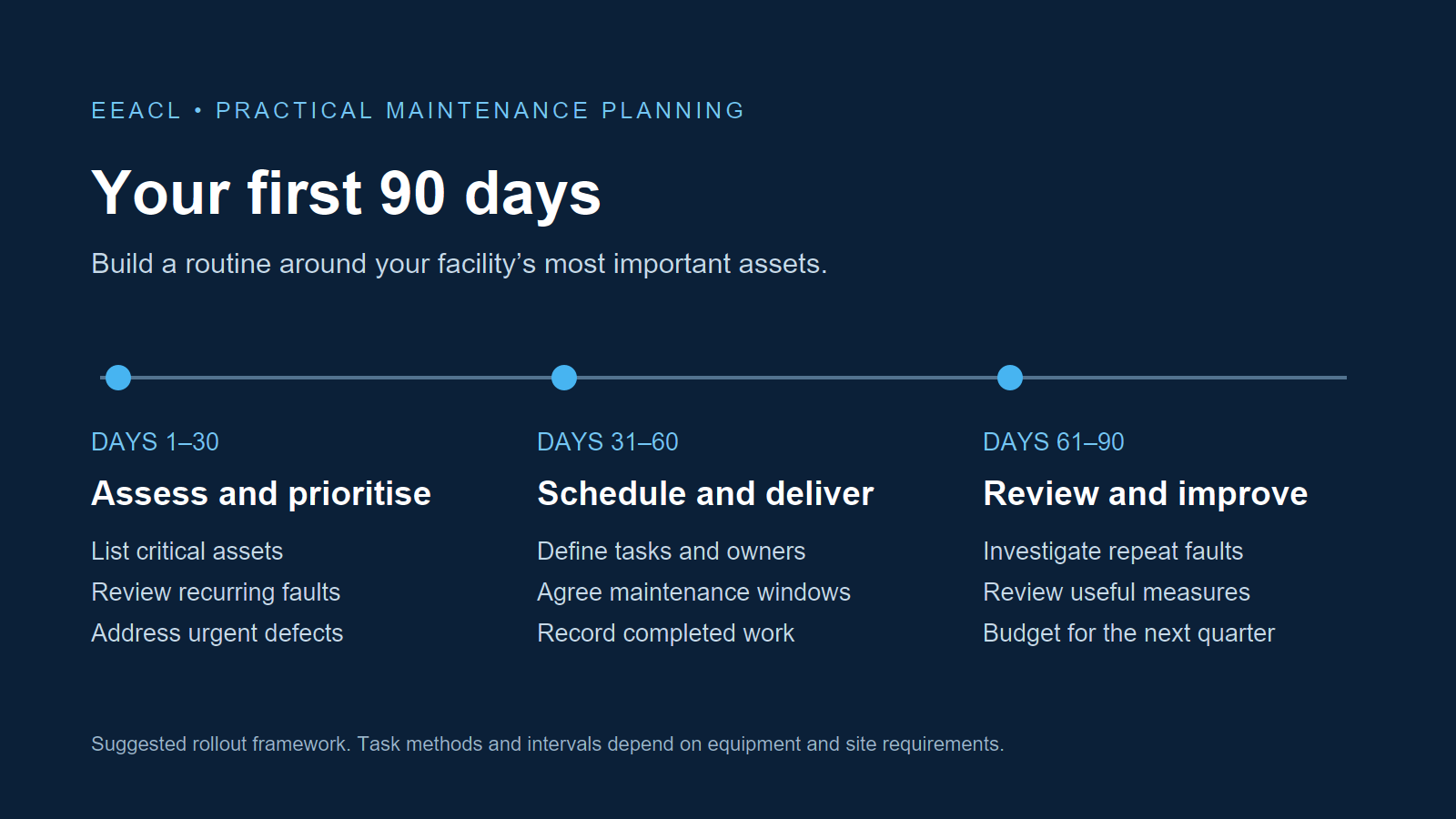
Start by choosing the right maintenance approach
Breakdown maintenance means responding after equipment fails or a defect disrupts its intended function. Preventive maintenance uses planned intervals, such as operating hours or calendar dates. Condition-based maintenance responds to evidence of deterioration, such as a measured change in vibration or temperature.
These approaches can work together. A low-cost, non-critical item with a readily available replacement may reasonably run to failure. A water pump serving the entire property needs a different decision.
The Pacific Northwest National Laboratory explains these distinctions in its maintenance approaches guidance. The useful starting point is to match the approach to the asset and the consequences of failure.
Your first objective is to make that choice deliberately.
Days 1-30: find the failures that deserve attention first
Build a usable asset register
Walk the site with someone who knows its day-to-day operation. List the equipment and building elements whose failure would affect safety, water supply, access, occupancy or essential work.
Depending on your facility, this might include pumps, tanks, electrical distribution equipment, generators, drainage, roof coverings and exposed steelwork. Start with one building or one essential system if the site is large.
Give each asset a unique reference. Record its location, function, make and model where available, known condition and maintenance history. Add the responsible person and a link to its manual or technical documents.
A register becomes useful when someone can find the asset, understand its purpose and see what needs attention next.
Reconstruct the recent repair history
Review invoices, call-out records, staff reports and photographs. For each significant incident, record:
- What failed and when it happened.
- How long the service was unavailable.
- What work was completed and what it cost.
- Whether the same symptom returned.
- What remains uncertain about the cause.
Keep confirmed findings separate from assumptions. “Pump replaced” describes an action. It does not establish why the pump failed.
Where records are missing, begin collecting them now. An incomplete but honest baseline is more useful than an invented history.
Rank assets by the consequences of failure
Look beyond the replacement price. A relatively inexpensive component can stop an essential service.
Use a simple initial classification:
| Priority | Consequence of failure | Initial response |
|---|---|---|
| Critical | Serious safety concern, essential service loss or potentially major damage | Escalate promptly, assess professionally and establish appropriate controls |
| Important | Significant disruption, with a workable temporary alternative | Plan corrective work and suitable recurring maintenance |
| Lower priority | Limited disruption and straightforward recovery | Use proportionate inspections or a documented run-to-failure decision |
Consider the availability of standby equipment, replacement parts and competent contractors. A failure with a two-week parts lead time deserves different preparation from one that can be resolved locally the same day.
PNNL’s guidance on prioritising maintenance actions supports aligning maintenance decisions with facility needs and available resources. Your priority list should help management decide where the next maintenance hour or cedi will do the most useful work.
Separate immediate defects from scheduled work
A 90-day programme does not make an active hazard safe to defer. Electrical damage, suspected structural movement or other serious defects need assessment and controls appropriate to the situation.
Assign technical inspections and repairs to competent personnel. Follow equipment-specific isolation procedures and safe access arrangements. Staff observations can trigger an inspection; they do not replace specialist diagnosis.
By day 30, aim to have an initial asset register, a prioritised defect list, a named coordinator and a record of recent breakdowns.
Days 31-60: turn priorities into work people can complete
Write specific tasks with clear outcomes
“Check pump” leaves too much room for interpretation. A useful maintenance task identifies the asset, the work, the person responsible and the evidence needed to close it.
For example, a pump inspection record could require a competent technician to document operating observations, compare relevant readings with approved limits and raise corrective work for any abnormal findings.
Set task intervals using the manufacturer’s instructions, operating hours, service conditions and previous failures. Dust, moisture, loading and exposure may affect the programme. Avoid assigning every asset the same monthly schedule simply because it is convenient.
The U.S. Department of Energy’s operations and maintenance guide provides background on maintenance programme design and equipment care. It is a general reference, published in 2010, rather than a substitute for the current instructions for your equipment or requirements applicable in Ghana.
Protect time for planned maintenance
Agree maintenance windows with the people who use the facility. A school, occupied office and production workshop will have different constraints.
Before a task enters the weekly schedule, confirm that the necessary technician, parts, tools, access and approvals are available. Identify any service interruption and tell affected users what to expect.
Schedule an amount of work the team can realistically deliver. When emergency jobs interrupt the plan, record the reason and reschedule displaced tasks explicitly.
Prepare spares around real failure risks
For critical assets, check which replacement parts have long lead times or limited local availability. Record the correct specification and supplier details before an urgent order is needed.
Stock decisions should consider storage conditions, shelf life, cost and whether a part can serve several assets. A cupboard full of unidentified parts creates another maintenance problem.
Close jobs with evidence
Every completed job should leave a short, usable record: the finding, work performed, parts used, relevant test results and any follow-up action.
Ask for the same information from external contractors. Record who accepted the work and whether the asset was returned to service.
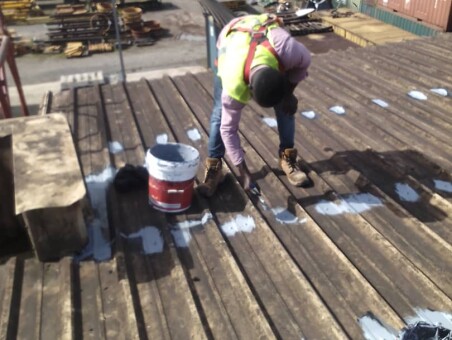
An example of a practical maintenance task list
Use this as a planning aid. The responsible professional should confirm the task method, acceptance criteria and frequency for each asset.
| Asset or system | Task to define | Trigger or interval to establish | Completion evidence |
|---|---|---|---|
| Roof and rainwater drainage | Inspect accessible areas and investigate reported leaks; arrange safe access for roof work | Site exposure, inspection requirements, weather events and defect history | Location-tagged photographs, findings and corrective actions |
| Water pump and associated controls | Assess operation and investigate abnormal noise, leakage or performance | Manufacturer guidance, operating duty and condition trends | Readings, observations and technician’s findings |
| Electrical distribution equipment | Arrange inspection and testing appropriate to the installation | Applicable requirements, equipment instructions and competent assessment | Inspection or test record and defect actions |
| Standby generator | Service and test according to the equipment and installation requirements | Manufacturer’s calendar and operating-hour limits | Service record and relevant test results |
| Exposed steelwork | Assess coating deterioration and corrosion; define suitable treatment | Exposure, existing condition and engineering assessment | Condition photographs and repair specification |
EEACL’s engineering and consultancy capabilities include electrical and mechanical services, civil engineering, water-related works and maintenance of civil structures. Those disciplines can be relevant when a recurring defect crosses the boundaries between equipment, installation and building condition.
Days 61-90: use the records to improve the plan
Review recurring faults before authorising another repeat repair
Suppose a water pump keeps losing performance after servicing. Possible causes might involve the pump, controls, operating conditions or the wider water system. Repeating the same intervention without checking the cause can leave the underlying problem in place.
Use the maintenance history to ask focused questions. Did the fault occur under similar conditions? Were the relevant measurements recorded? Was the previous repair verified? Does the installation match the intended duty?
This is an illustrative scenario, not an EEACL case study. Diagnosis requires evidence from the actual system.
Track a small set of useful measures
Choose measures the team can record consistently:
| Measure | Simple calculation or record | Decision it supports |
|---|---|---|
| On-time planned task completion | Tasks completed by their due date divided by tasks due multiplied by 100 | Whether the schedule fits available capacity |
| Unplanned downtime | Hours each critical asset was unavailable unexpectedly | Which failures disrupt operations most |
| Repeat faults | Recurrences on the same asset within a defined review period | Which repairs need further investigation |
| Overdue critical work | Open critical tasks past their approved due dates | Where management intervention is needed |
| Maintenance expenditure | Labour, contractor and parts costs, recorded consistently | What resources the next period requires |
For example, completing 18 of 20 tasks by their due dates gives a 90% on-time completion rate. That figure describes delivery of the schedule. The condition of the assets and quality of the work still need review.
Compare similar periods and account for operating hours, workload and seasonal conditions. Ninety days can establish a baseline and reveal gaps. It may be too short to demonstrate a lasting change in reliability or total cost.
Adjust the programme and fund the next quarter
Review tasks that repeatedly find defects, tasks that are consistently delayed and work that appears to add little value. Change intervals only with an appropriate technical basis.
Separate the next quarter’s budget into recurring maintenance, outstanding corrective work and proposed replacements or improvements. Give each significant item a reason, estimated cost and consequence of delay.
Management can then see the choices involved, rather than receiving another unexplained request for “maintenance money”.
What you should have by day 90
A workable first programme should leave you with:
- An asset register covering the agreed initial scope.
- A risk-based priority list and documented outstanding defects.
- Maintenance tasks with owners, intervals and completion criteria.
- A schedule coordinated with facility operations.
- Job records that support diagnosis and follow-up.
- An initial performance baseline and a budget for the next quarter.
The next step is to repeat the routine, improve the records and extend coverage as capacity allows.
Frequently asked questions
Can a small facility start with a spreadsheet?
Yes. A spreadsheet can hold the asset register, task schedule and job history for a small initial scope. Assign responsibility for updating it and store supporting documents where the team can find them. Consider dedicated maintenance software when coordination, reporting or asset volume makes the spreadsheet difficult to manage.
How often should preventive maintenance be carried out?
There is no single interval for every asset. Use manufacturer instructions, operating duty, condition, failure consequences and applicable inspection requirements. Review the intervals as reliable site records become available.
Should every asset receive preventive maintenance?
Choose the approach asset by asset. Planned maintenance is valuable where an appropriate task can reduce a meaningful failure risk. A documented run-to-failure approach may suit some low-consequence items with readily available replacements.
Can a maintenance plan eliminate breakdowns in 90 days?
Breakdowns can still occur. The first 90 days should establish priorities, routine work and records that support better decisions. Any claim about reduced downtime or savings needs evidence from your facility over a suitable period.
Discuss your facility’s maintenance priorities with EEACL
If recurring leaks, equipment faults or deteriorating structures are disrupting your facility, bring the repair history and current defect list to a technical discussion.
EEACL’s multidisciplinary background provides a starting point for discussing building, water, electrical and mechanical concerns. Contact EEACL about your maintenance requirements and share your site location, affected assets and recent problems so the appropriate scope can be discussed.
You can also review EEACL’s completed project gallery for examples of its published work.
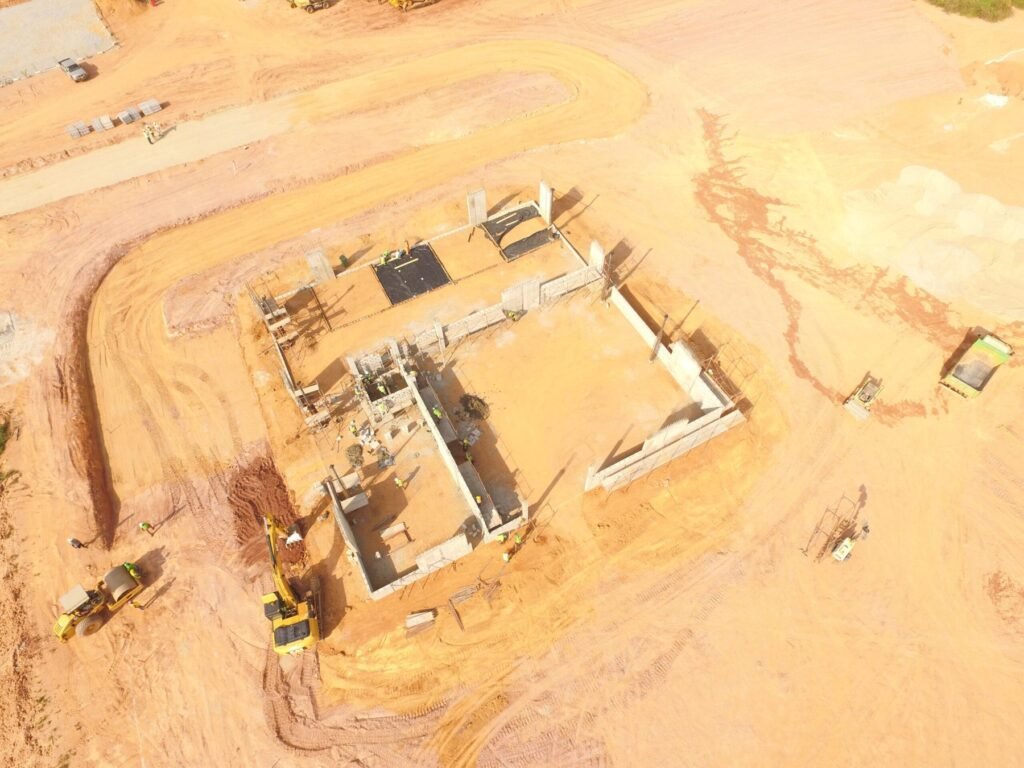
Concrete Quality in Hot Weather: What Clients Should Ask Before a Pour
Concrete quality depends on preparation, placement, curing and evidence. Understand the questions that help clients oversee a pour without substituting guesswork for the engineer’s specification.
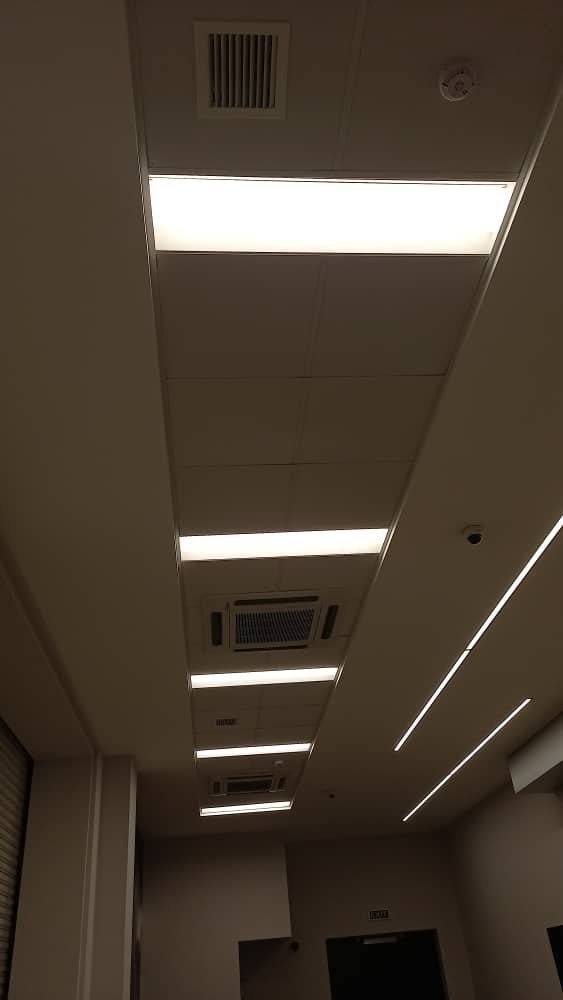
MEP Coordination: The Decisions to Resolve Before Ceilings and Walls Close
Coordinate electrical, mechanical and plumbing systems around structure, access and operation—not just clashes. A practical guide to design reviews, commissioning and handover.
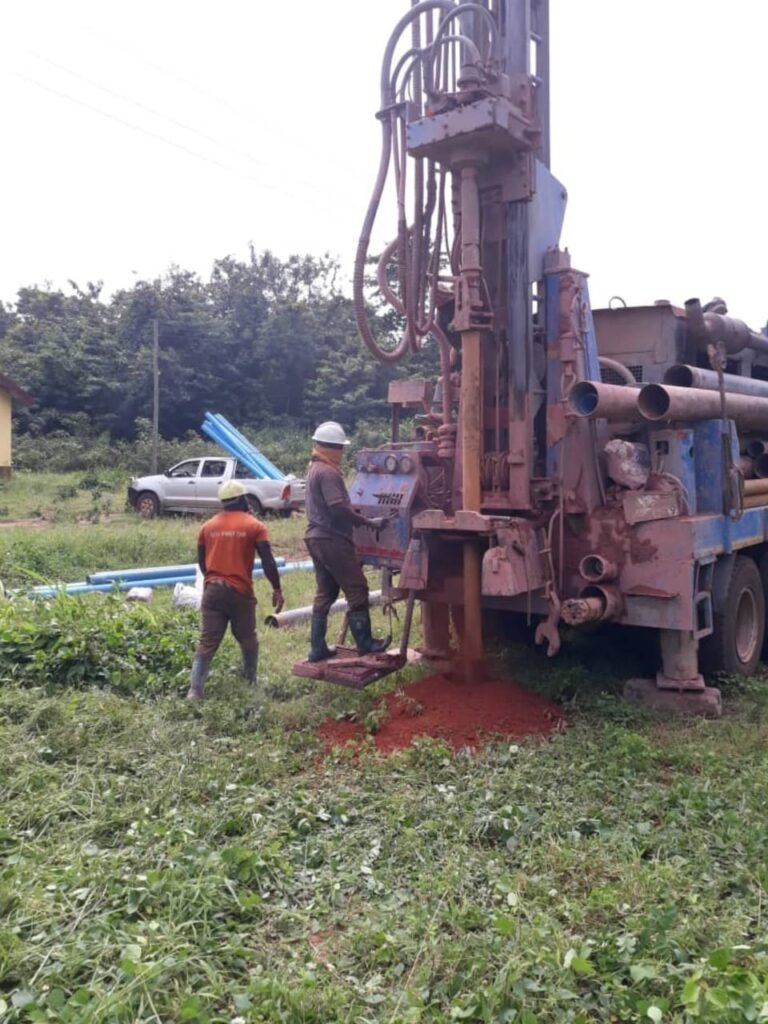
Planning a Borehole in Ghana: From Water Demand to a Reliable Supply
A productive borehole is only one part of a dependable water system. Plan demand, investigations, water quality, storage, treatment and operating responsibilities together.

Before You Build: A Project Brief That Helps Your Engineering Team Make Better Decisions
Turn an initial idea into a useful engineering brief: define the outcome, gather site information, separate assumptions from facts, and agree the decisions needed before design begins.